What has been decided
The government confirmed the new minimum standard in its response on improving the energy performance of privately rented homes, published in January 2026. On 4 November 2026 it published a factsheet for the Energy Independence Bill setting out how the standard will be enforced. The aim is for the rules to come into force in 2027, subject to Parliament, so treat the detail as final in direction but not yet law.
- Who: private landlords of all tenancies in scope.
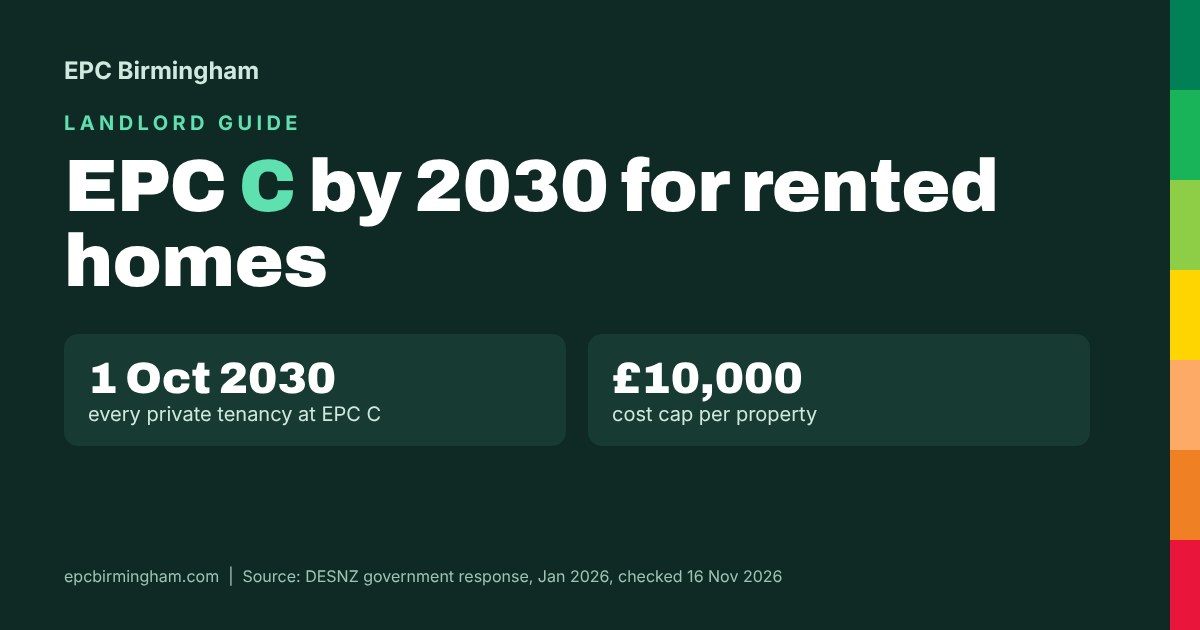
- The standard: EPC C, met by 1 October 2030. There will not be an earlier compliance date for new tenancies.
- Enforcement: councils get new powers, and a maximum civil penalty of £30,000 per breach for each non-compliant property.
The £10,000 cost cap
You will only be required to spend up to £10,000 per property, over a 10-year period. A few details matter:
- Work installed since 1 October 2025 counts towards the cap.
- Third-party funding you receive can count towards it, but Boiler Upgrade Scheme grants cannot.
- For homes worth less than £100,000, the cap is lower: 10% of the property's value.
If you spend up to the cap and still can't reach C, you can register a cost cap exemption, which is valid for 10 years.
The 2029 window: lock in a C on today's rating
EPCs are being reformed. If your property gets a C or higher on the current energy efficiency rating before 1 October 2029, it will count as compliant until that EPC expires or is replaced. After that, the standard is set against the new EPC: a primary standard on fabric performance, plus a secondary standard on either the heating system or smart readiness, whichever you choose.
That makes the next few years the time to plan. If a property is close to C now, getting the work done and a new EPC lodged before October 2029 gives you certainty for the life of that certificate.
- 1 Oct 2025Work starts countingImprovements installed from this date count towards the £10,000 cap
- Jan 2026Standard confirmedGovernment response sets EPC C by 2030
- 4 Nov 2026Enforcement set outEnergy Independence Bill factsheet: council powers, £30,000 maximum penalty
- 2027Rules aimed to take effectSubject to Parliament
- 1 Oct 2029Lock-in window closesA C on today's rating before this date counts until that EPC expires
- 1 Oct 2030DeadlineEvery private tenancy in scope at EPC C
Exemptions
Exemptions still exist. Most, such as when a needed third party (a tenant, superior landlord or planning authority) refuses consent, are typically valid for 5 years. The cost cap, property value and negative impact exemptions are valid for 10 years.
What to do now
- Check the current rating and expiry date of each rented property's EPC.
- If a property is D or below, get a new EPC to see exactly which measures would lift it to C, and in what order.
- Price the work. Our upgrade calculator shows the cheapest route to C, and RetrofitCost.com checks retrofit costs and grants.
- Keep receipts for anything installed since 1 October 2025, as it counts towards the £10,000 cap.
- Aim to have a C lodged before 1 October 2029.
Letting an HMO? See the landlords and HMOs section for how the EPC reforms affect shared houses.
This is general information, not legal advice. Check the government guidance for your own property.
Sources
- DESNZ, Improving the energy performance of privately rented homes: government response, January 2026 (checked 16 November 2026)
- GOV.UK, Energy Independence Bill factsheet: domestic private rental sector minimum energy efficiency standards enforcement, 4 November 2026 (checked 16 November 2026)